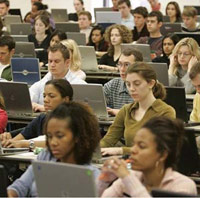
For the last 11 years I have taught classes in higher education and have seen the way that students interact on campus, what they bring to class, how much they pay for textbooks, and how they use their textbooks. This topic is quite a hot one on college campuses around the country and with the tremendous popularity of the iPad, naturally many people are looking to the iPad as the solution to all their problems, so I thought I would offer my 2 cents.
Let me first say that it is pretty disgusting what students have to pay for textbooks nowadays. I know, I know… the publishers would say how expensive it is to actually create content for a textbook and the length of the process it takes to bring it to market… blah blah blah. That is even more evidence to me that the way things have been done in the past isn’t the future. Things are going to have to change, the question is… change to what? I sure wish I had the definitive answer to that, because I would be in pretty hot demand right now for sure if I did! But what I do have an opinion on is the recent love affair with the iPad.
Let me confess that I do have an iPad in my office. I didn’t buy it with my personal money, and after spending some time with it I came to the conclusion that I wouldn’t ever pay that kind of money for what you get. But I digress. I asked all my staff members to use the iPad and report back to me what they thought about it… pros and cons, etc. It was interesting to see the perspectives of my staff, who are both male and female, young and not-so-young, PC fans and Mac fans. This isn’t a post about the pros and cons of the iPad, so I won’t get into that. But all my staff did have opinions, as did I, about what it would be like to use the iPad as a textbook.
I think it is valuable to talk about how students use textbooks. I don’t know if you have ever seen the textbooks that are turned back in at the end of the semester, but it gives you a glimpse about how students use them. Being able to highlight and mark important parts of the chapters is critical. It is important to be able to make a note in the margin about the story that your prof just told you that relates to something in the chapter. And it is important to be able to flip back and forth really quickly through the chapter to find something you need, like that note you made.
I don’t care which e-Reader you pick (including the iPad), you can’t do any of those things. Sure, you can search and you have some limited note-taking ability, but nothing that approaches having a textbook. Flipping pages on the iPad may not be ‘magical’ like Steve Jobs purports, but it is pretty nice. But regardless of how nice it is, it ain’t fast enough… at least not for a student during crunch time before finals who is trying to find that elusive note he wrote in the margin of some page. You have to hold these e-readers in your hand or lay them flat on the desk. It is awkward. The keyboard on the iPad is ok, but it is too big for many people to use as a thumb keyboard. So you have to lay it in your lap, or flat on a desk. Again, awkward.
There are numerous studies that have already been done, like this one: http://chronicle.com/blogPost/Kindle-Failed-Tests-at-Seve/23253/, that prove what I’m saying. Things are just not ready for textbooks to be replaced with e-readers, or iPads, or e-books. While e-readers are more affordable than they were a year ago, the iPad is just too darn expensive. Apple products always come with a premium price, and while some students’ parents will spring for one, most students can’t afford them. Additionally, Apple’s attitude for all their products is that they are disposable. You can’t replace the battery or add expandable storage for a reason… they don’t want you to be able to do that. They want you to buy the new one that comes out next year. And that ain’t gonna change. And that ain’t smart for a college student on a budget.
The perfect storm will be when a device comes along that delivers rich multimedia content that pulls much of the content from the internet or as-needed, at a price that students can afford, in a form factor that allows rapid retrieval of user-generated notes and chapter content. (Strange… that kinda sounds like a laptop, doesn’t it??) Plus, textbook publishers aren’t ready to deliver that kind of rich content anyway. And if they ever do, they’ll probably argue that prices need to go up, not down, then it won’t matter that we worked so hard to stop printing paper textbooks.
The iPad in my opinion, and in the opinion of my staff as a whole, is a nice device to consume media… email, watching videos, listening to music, and playing games. I don’t care how much the iPad fans look to the iPad as the solution to this problem… it ain’t. And it never will be because there are simply too many reasons against it.

{ 7 comments }
i disagree. there are many more pro the cons about replaceing texts books, and it is unfair to say that it will never happen, because every day there are new apps and ideas that are added to the app store.
Hey Brad, thanks for taking the time to comment. I do actually agree with some of what you said, but I still believe that the iPad will never replace textbooks. I go to higher education technology conferences multiple times a year and I talk to these textbook publishers… noone is even close to creating that interactive, media-rich textbook that everyone (including me) thinks is the ideal. Too much time, effort, and cost goes into making something like that, and the cost for such a textbook would be even more than the overpriced textbooks students are paying for now. So it would be a huge mistake for colleges to force that on students, in my opinion. College is expensive enough as it is.
The most bang for a student’s buck right now is a laptop, and I don’t see that changing any time soon. Like I said at the beginning of my article… my 2 cents!! Although I suppose that it’s now 3 cents! Thanks again.
I completely disagree. Having had an iPad for about a year and, being a classroom teacher, I can definitely see the potential for such a device to replace and surpass the static, single media textbook. You can flip precisely to any page you want instantly, unlike a book. You can also make all the highlights and marks you want and the book even keeps track of them for easy access in the table of contents. I would love to have my textbook catalog all my highlights, but that isn’t ever going to happen in a typical textbook. Plus, buy 5 $120 textbooks and a multipurpose $400 device that lasts years and years doesn’t seem so bad. Especially one that can embed instructional video, interactive pictures and comprehension checking sections. I think you all are too resistant to change.
Great comments Scott. I agree with much of what you said. Being in higher education myself, I see all the time where iPads are thrown around as the solution to alot of things… and large amounts of attention are given to them simply because of the novelty of the device. I have lived with one for almost 7-8 months now, and I am still convinced that iPads are content consuming devices, not content creation devices. Apple has these things too locked down and everything is associated around ‘the app’. That won’t work in many situations. And relying on textbook publishers to constantly update their ‘app’ just ain’t gonna work long term. It is a great device for playing games and looking at most webpages (if you don’t care about flash) and checking email once in awhile. Other than that, I don’t recommend them. For me, the laptop simply can’t be replaced in a student’s education environment. thanks for commenting!!
Your analysis asks if the iPad (or any e-reader) can replace a textbook, and I agree that it cannot be a textbook. That said, I think that using and iPad in school will be a different experience altogether. We won’t interact with it is the ways that we do with a textbook, but that doesn’t mean that the textbook is better; it’s a whole different approach. It’s like small-schools vs. large comprehensive high schools. They are two totally different structures and much that works in one will not work in another (ex. discipline policies).
I had people from Holt McDougal out last week trying to get our school to get our new math textbooks on the iPad. My analysis was that the iPad isn’t ready for high schools yet. Until the teacher can capture, control, freeze, and monitor iPads in there room, it won’t be suitable for high school.
Great work keep it coming, best blog on earth!
this post is very usefull thx!
{ 1 trackback }